THE THINKING BEHIND THE BRIEF
A view is useful.
Conditions make it actionable.
The brief connects a market thesis to a specific instrument, a catalyst and the price behavior worth watching. It also gives you the competing case: what would make that view stop making sense.
New to the terminology? Read the research glossary →
Read the status before the level.
Watch: an idea worth following, with a catalyst or question still to resolve. It is not yet a complete entry plan.
Conditional setup: a plan that depends on stated price behavior, within a stated time window. A level alone does not satisfy those conditions.
Invalid / stand down: the setup no longer meets its conditions. A new opportunity needs a fresh assessment; the original plan does not become valid just because price later turns.
The level is a reference, not a promise.
A price touching a level is different from holding it. Each setup explains what confirmation means and states its Invalid—the condition that calls for standing down. Gamma levels are model estimates, not guaranteed turning points.
See the level in context.
SPY’s September 4 low at 769 is the immediate reference in this historical example. Below it sits Thursday’s 767.45 low. Overhead, 772.87 comes before the weekly high at 774.03.
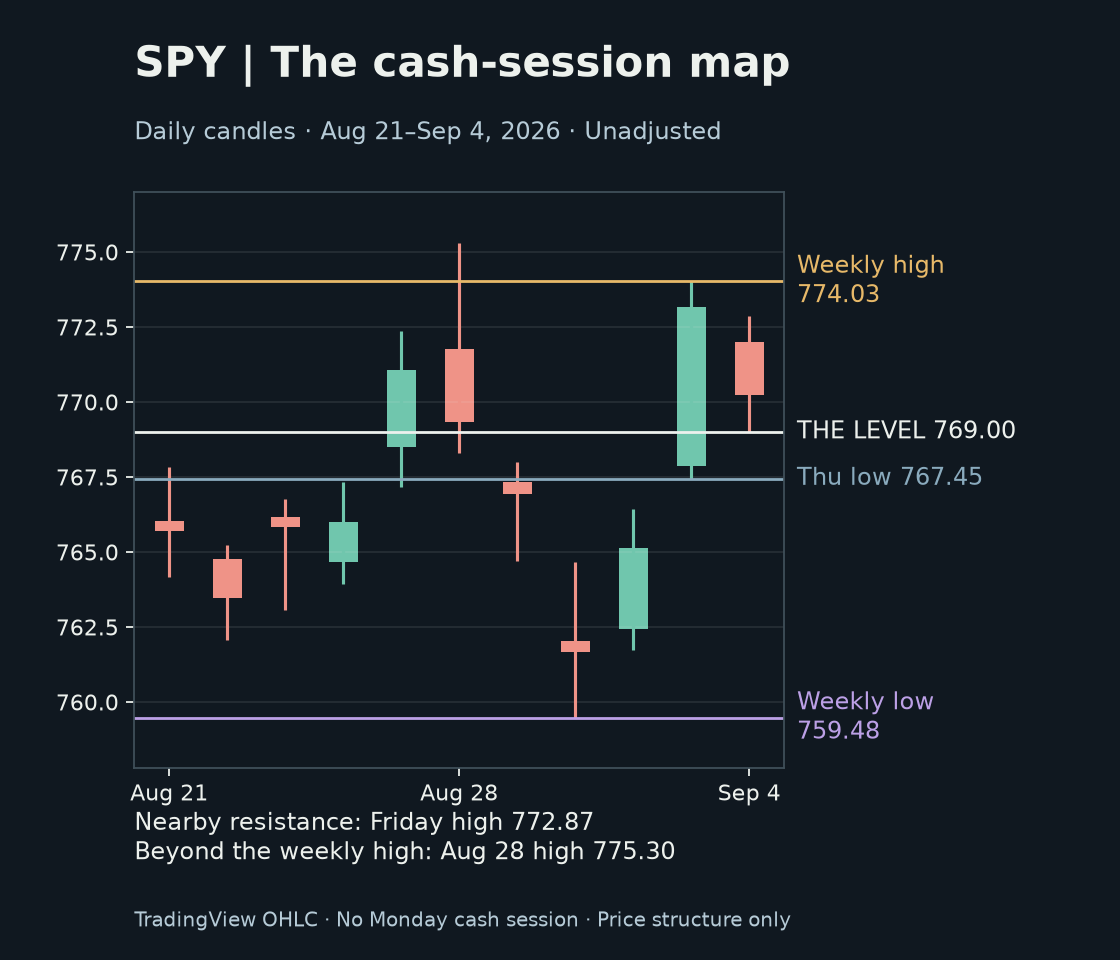
A hold keeps the recovery question open. A break shifts attention to the next downside reference. Neither tells you to enter on its own: the setup still needs confirmation, an Invalid and enough room to its exit.
Gamma walls add modeled context where available. They remain distinct from observed highs and lows; this SPY example shows price structure only.
The close puts the idea in context.
After the Bell explains whether the conditions appeared, whether the thesis held, and what changed. Meeting an entry condition and reaching the intended outcome are different questions. Some ideas remain in play. Others fail or never trigger. When the evidence cannot settle a question, the review says so.
Carry the lesson into the next session.
A failed entry does not always overturn a macro thesis. An intact thesis does not justify ignoring a failed setup. The next brief follows that distinction with updated context and fresh conditions.
The available September 4 examples were reconstructed after the session. They illustrate the format, not live calls or subscriber returns.
Questions about access or your membership? Contact support@killthelevel.com.
Kill the Level publishes general market research for educational and informational purposes only. It does not provide personalized investment advice. The analysis does not account for your financial circumstances, objectives or risk tolerance. Past, hypothetical, modeled or backtested results do not predict future results. Investing and trading involve risk, including possible loss of principal.